JCL
Vol. 3, No. 3.1 (2026)
pp. 1-10
Open Access
Metadata Indexing Ready
Reformulation of the Regulations on the Right to Freedom of Expression for Academics in the Digital Space in Enforcing the Crime of Defamation
Erdian
Boy Nurdin
Institutional Publisher / Affiliation:
Indonesian Journal Publisher
Abstract
This study aims to analyze the problematic enforcement of defamation offenses against academic expression in the digital space and formulate a model for reformulating its regulations based on the protection of academic freedom from the perspective of human rights and a democratic rule of law. The 1945 Republic of Indonesia Constitution, Law Number 39 of 1999 concerning Human Rights, Law Number 1 of 2024 concerning Electronic Information and Transactions, the National Criminal Code, and the International Covenant on Civil and Political Rights are all reviewed as part of the normative juridical research method with a statutory and conceptual approach, and relevant Constitutional Court decisions. The research results indicate that Indonesian positive law still faces problems in the form of a dualism of the legal regime between the Criminal Code and the ITE Law, the ambiguity of elements of offenses, such as attacking honor, accusing someone, and public knowledge, and the absence of normative parameters capable of distinguishing scientific criticism from personal attacks. These conditions have triggered the criminalization of lecturers, researchers, experts, and observers, which has resulted in the emergence of a chilling effect and overcriminalization of academic freedom in the digital space. This study proposes a model of ius constituendum through a reformulation of Article 27A of the ITE Law, adding explicit exceptions for academic expression conducted in scientific forums, research publications, and opinions based on scientific methodology, as long as they are conducted in good faith and in the public interest. The reformulation includes the implementation of a balancing test, specific evidentiary standards for scientific expression, indicators of good faith academic criticism, and strengthening non-penal settlement mechanisms through the right of reply, scientific correction, and reputation restoration. This model is expected to achieve proportional legal certainty between reputation protection and academic freedom of expression as pillars of digital democracy.
Keywords:
Academic Freedom of Expression
Defamation
Digital Space
Legal Reformulation
academic
expression
scientific
freedom
digital
reformulation
How to Cite & Export Metadata
Full-Text PDF Document
Live Preview
Having trouble viewing? Use the controls or open in a new tab.
Source Portal Galley
Machine-Readable Indexing Metadata (Dublin Core) ↓
<meta name="citation_title" content="Reformulation of the Regulations on the Right to Freedom of Expression for Academics in the Digital Space in Enforcing the Crime of Defamation">
<meta name="citation_journal_title" content="Journal Customary Law">
<meta name="citation_issn" content="3026-460X">
<meta name="citation_volume" content="3">
<meta name="citation_issue" content="3.1">
<meta name="citation_publication_date" content="2026">
<meta name="citation_doi" content="10.47134/jcl.v3i3.1.5880">
<meta name="citation_author" content="Erdian">
<meta name="citation_author" content="Boy Nurdin">
Digital Archival & Preservation Notice (COPE Aligned)
This page represents an archival record of the peer-reviewed manuscript published by Indonesian Journal Publisher. ActaNova provides permanent digital preservation and global open metadata accessibility. Copyright of the manuscript remains with the original authors or publisher in accordance with their designated license.
Full-Text & Access
View PDF Document Download PDF File Read at Primary Journal Portal Official Journal HomeIndexing Readiness Status
Google Scholar Tags
Active
Dublin Core & OAI-PMH
Compliant
DOAJ XML Schema 4.0
Valid
DOI Identifier
Registered
Publication Details
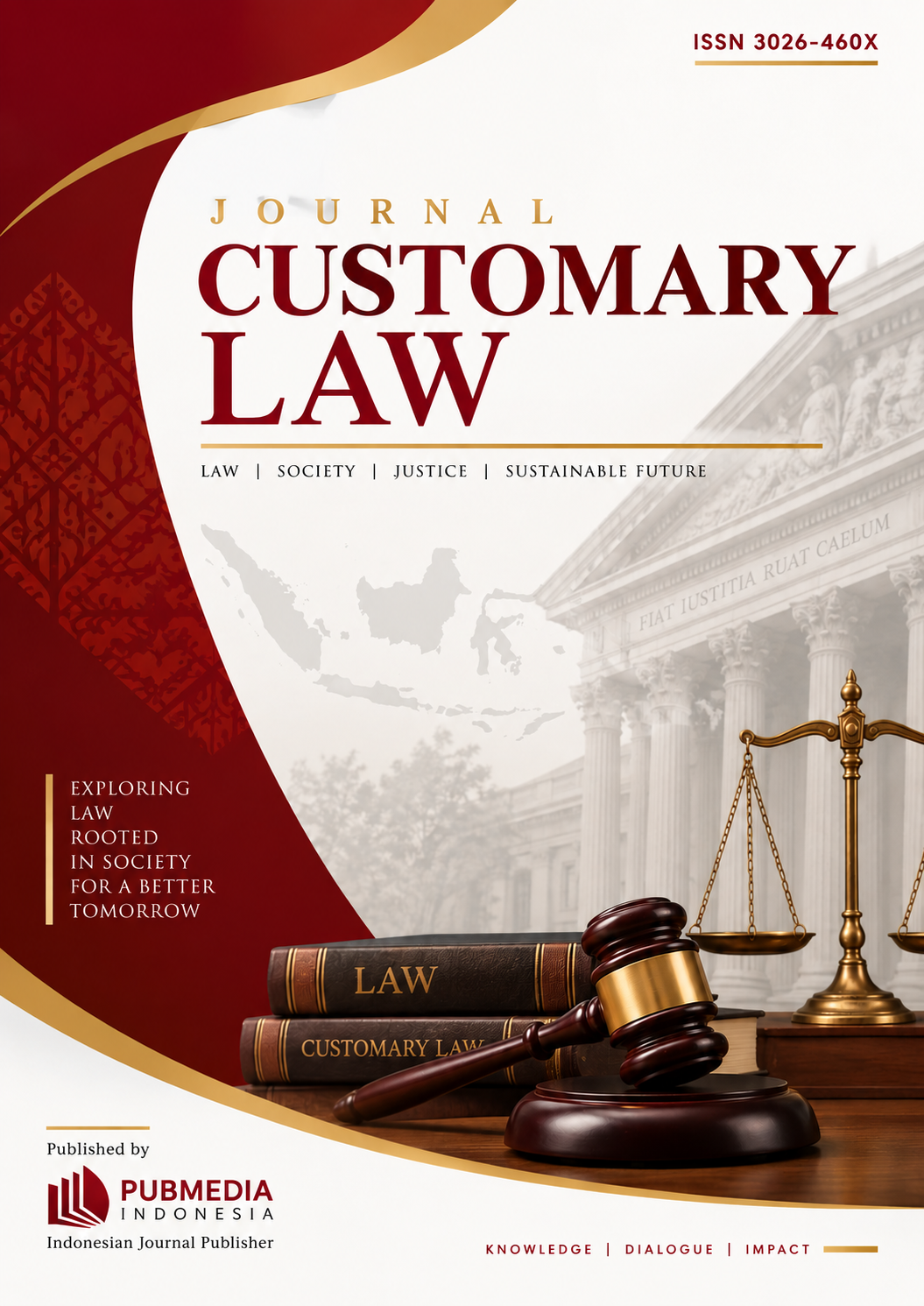
Journal Customary Law
Vol. 3 No. 3.1 (2026)
Managed By
Indonesian Journal Publisher
Publication Date
June 30, 2026
eISSN (Online)
3026-460X